Iron at Home: Build the Garage Gym That Finally Makes You Show Up
Stop Dreaming About the Perfect Setup and Start Lifting
Every serious lifter has had that fantasy — a fully decked-out personal training space with no wait times, no questionable locker room smells, and zero judgment when you want to grunt through a heavy deadlift set. The good news? That setup is more achievable than you think. The bad news? Most people who build home gyms end up using the barbell as a very expensive clothes hanger within three months.
At Brawny Jim's, we're not about aspirational nonsense. We're about what actually works. So let's break down how to build a home gym that becomes the cornerstone of your training life — not a guilt-generating dust collector.
Figure Out What Kind of Lifter You Actually Are
Before you drop a single dollar on equipment, be brutally honest with yourself about your training style. Are you a powerlifter who lives and dies by the squat, bench, and deadlift? A hypertrophy-focused bodybuilder who needs variety in their accessory work? A general strength athlete who likes to mix it up?
Your training identity should drive every equipment decision you make. A powerlifter can get by with a solid power rack, a good barbell, and enough plate weight to challenge them for years. A bodybuilder chasing muscle growth through volume might want a set of adjustable dumbbells and a cable attachment system. Neither setup is wrong — but buying equipment for the lifter you wish you were instead of the one you are is how garages get cluttered fast.
The Non-Negotiables: Equipment Worth Every Penny
If you're building from scratch, here's the honest priority list:
1. A Quality Barbell This is not the place to cheap out. A decent barbell from a reputable brand like Rogue, Rep Fitness, or Titan will last you decades. Expect to spend $200–$400 for something genuinely solid. A bad bar that bends under load or has stiff sleeves will make every lift feel terrible and can actually mess with your form.
2. Bumper Plates or Iron Plates Bumper plates are worth it if you're doing any Olympic lifting or if you train on a concrete floor. Iron plates are more compact and work perfectly for powerlifting-style training. Either way, buy enough weight to actually challenge yourself — don't stop at 200 lbs of total plate weight thinking you'll "add more later." Get ahead of your strength curve from day one.
3. A Power Rack or Squat Stand For safety and versatility, a power rack is king. It lets you squat, bench press, do pull-ups, and rack heavy loads without a spotter. If space is genuinely tight, a good pair of squat stands with safety arms can work — just know their limitations.
4. Adjustable Dumbbells If floor space is at a premium, a set of adjustable dumbbells like the Bowflex SelectTech or PowerBlock series is a game-changer. They replace an entire dumbbell rack and cost a fraction of the space.
5. A Flat/Adjustable Bench Don't skip this. A quality adjustable bench opens up incline pressing, dumbbell work, and seated exercises that round out any serious training program.
Space Optimization: From Studio Apartment to Two-Car Garage
You don't need a massive space to train hard. Here's how to make different footprints work:
Tight apartment or spare bedroom (under 150 sq ft): Focus on a compact folding squat stand, a single barbell with weight storage pegs, and adjustable dumbbells. Wall-mounted pull-up bars take up zero floor space. Keep it minimal and intentional.
One-car garage or larger bedroom (150–300 sq ft): This is the sweet spot for most home gym builders. A full power rack, a flat bench, and a decent dumbbell selection fits comfortably here. Add a rubber flooring mat and you've got a real training environment.
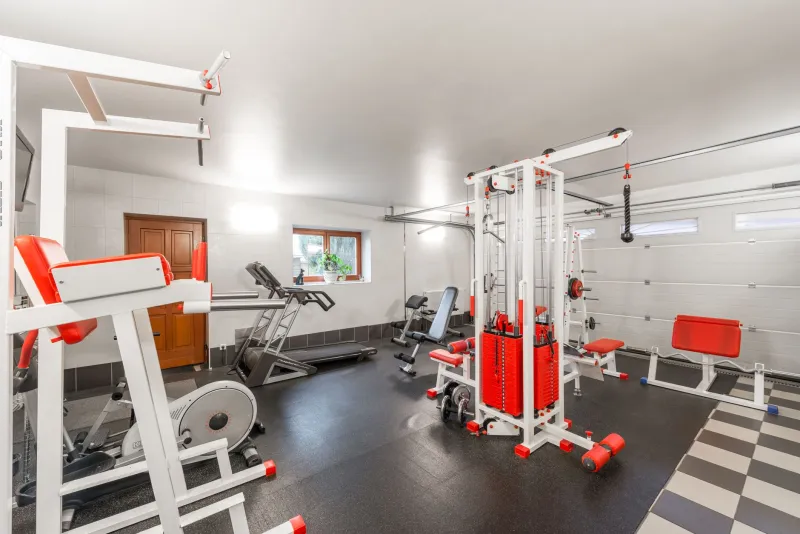
Two-car garage or basement (300+ sq ft): Now you're cooking. You have room for a dedicated deadlift platform, a cable machine or functional trainer, and even some cardio equipment if that's your thing. Don't fill space just because you have it — every piece should earn its footprint.
The Real Reason Home Gyms Fail (And How to Fix It)
Here's the uncomfortable truth: most home gyms get abandoned because of psychology, not equipment. The commercial gym has an edge that's hard to replicate — social accountability, a dedicated environment that signals "this is where I train," and the simple act of leaving your house to do something.
At home, the couch is 20 feet away. Netflix is one click away. The mental friction of transitioning from "home mode" to "training mode" is real, and if you don't address it, even the best equipment setup won't save you.
Here's what actually helps:
Create a visual boundary. Even in a small space, define your gym area clearly. Rubber flooring, good lighting, and keeping the space clean and organized signals to your brain that this area has a purpose. Treat it like a commercial gym — no random boxes of junk stacked in the corner.
Keep a training log visible. Whether it's a whiteboard on the wall or a notebook on the bench, having your program written out in your gym space reinforces commitment. You walk in, you see the plan, you execute.
Set a non-negotiable start time. The flexibility of a home gym can work against you. Without a "the gym closes at 10 PM" deadline, it's easy to keep pushing your session back. Pick a time, treat it like an appointment, and protect it.
Add some atmosphere. Sounds minor, but a good speaker system, the right playlist, and even some motivational posters or photos of your goals can dramatically change the energy of a space. Your home gym should feel like your gym — not a storage room with some weights in it.
The Long Game
Building a home gym is a long-term investment in your training lifestyle. Done right, it eliminates every excuse — no commute, no wait times, no membership fees, no off days because the gym was closed. The iron is always ready when you are.
Start with the fundamentals, buy quality over quantity, and design your space with your actual training habits in mind. The lifters who get the most out of home gyms aren't the ones with the most gear — they're the ones who built a space they genuinely want to walk into every single day.
Get the space right. Get the mindset right. Then get to work.