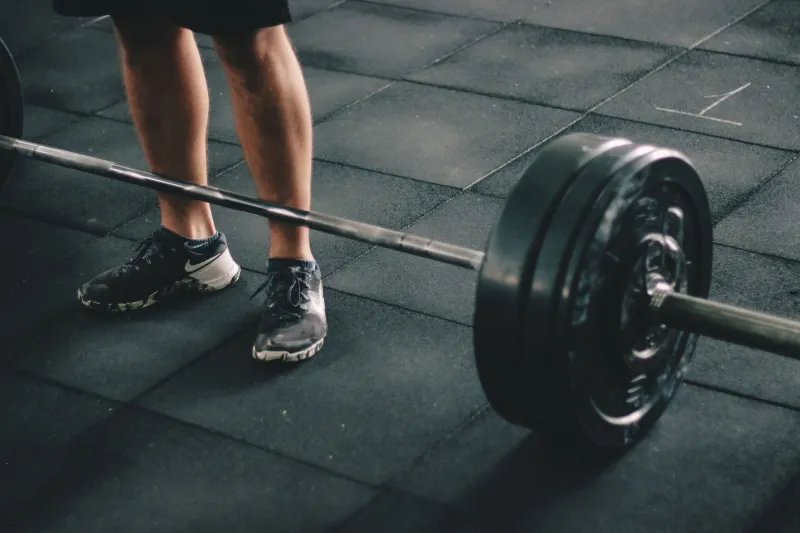
The Real Cost of Lifting Stupid: How One Bad Decision at the Bar Can Run You $10,000 in the Hole

Let's talk money for a second.
Not the money you're spending on pre-workout, protein powder, or that lifting belt you bought after watching one too many YouTube videos. We're talking about the money — the real money — that walks right out the door the second you load the bar heavier than your body can actually handle.
Ego lifting isn't just a training mistake. It's a financial one. And for a surprising number of guys who train seriously in the US, it's a mistake that ends up costing somewhere between a used car and a decent vacation. Sometimes both.
The Invisible Price Tag on Every Stupid Rep
Here's how it usually goes: You've been training for a while. You're making progress. Then someone in your gym — or worse, someone on Instagram — posts a deadlift that makes yours look soft. So you add weight. More than you're ready for. You get the lift (barely), film it, post it, and collect your likes.
Then, three weeks later, your lower back is screaming. Or your shoulder won't rotate right. Or your knee sounds like a bag of gravel every time you go down stairs.
At that point, the real billing cycle begins.
A single orthopedic consultation in the US runs anywhere from $200 to $400 out of pocket, depending on your insurance situation. Throw in an MRI — which is often the next step when soft tissue damage is suspected — and you're looking at $400 to $3,500 depending on your coverage and location. Physical therapy, if your injury is serious enough to warrant it, can run $150 to $350 per session. Most injury rehab programs require 12 to 20 sessions minimum.
Do that math and you're staring at a potential bill north of $5,000 before you've even considered surgery, which for a labrum repair or a torn meniscus can push $15,000 to $30,000 even with insurance.
All of that, because the bar had too many plates on it.
Real People, Real Receipts
Take Marcus, a 28-year-old from Chicago who had been lifting seriously for four years. He was strong — genuinely strong — with a 405-pound deadlift he'd earned through years of consistent, smart training. Then he started chasing a training partner who pulled 455. Over six weeks, Marcus pushed his working weight past what his body was ready to stabilize. One afternoon pull session ended with a herniated disc at L4-L5.
His out-of-pocket costs over the following eight months: $2,800 in physical therapy, $1,100 in imaging and specialist visits, $600 in lost gym membership fees while he was sidelined, and roughly $1,500 in supplements and programming he bought trying to maintain progress during recovery. That's over $6,000 — and that's before accounting for the emotional cost of watching his strength numbers crater back to beginner territory.
"I basically paid six grand to go back to pulling 185 with a physical therapist watching me," he said. "It took two more years to get back to where I was. Two years."
Then there's Devon, a 33-year-old from Atlanta who tore his pec on a bench press he had no business attempting. Surgery, rehab, and the downstream costs — including six months of not being able to work his physical job at full capacity — ran him close to $12,000 total. His lifting partner, who spotted him that day, told him afterward the form looked off from the first rep.
Neither of these guys are outliers. This is happening in gyms across the country every single week.
The Gains You Can't Buy Back
Here's the part that doesn't show up on any invoice: the muscle you lose while you're rehabbing.
Research on muscle atrophy during extended inactivity is pretty grim. You can lose meaningful muscle mass in as little as two to three weeks of detraining, and for longer injuries — the kind that keep you out four to six months — you can be looking at losing a significant chunk of the size and strength it took you years to build.
You can't buy that back. You have to earn it all over again, rep by rep, just like you did the first time. Except now you're doing it older, potentially with scar tissue, and possibly with a movement limitation that wasn't there before.
The supplement industry would love to sell you something that speeds that process up. Spoiler: nothing on the market undoes what a preventable injury does to your training timeline.
What Smart Progression Actually Looks Like
None of this means you need to train timid. Brawny Jim's isn't in the business of telling you to leave weight on the floor. But there's a massive difference between training at the edge of your capacity — which builds strength — and training past it to impress people who aren't paying your medical bills.
Smart progression means adding weight when your form is genuinely locked in, not when it's "good enough." It means your top sets feel hard but controlled, not like a survival situation. It means checking your ego at the door and accepting that a 10-pound PR every few weeks is a fast rate of progress — not a slow one.
It also means being honest about why you're adding weight. Is it because your body is ready? Or is it because someone posted something that made you feel like you were falling behind?
Those are two very different reasons to load a bar, and only one of them ends with you making progress.
The Math Is Simple
Smart training is free. Ego lifting has a price list, and it's a long one.
The lifters who end up genuinely jacked — the ones who are still in the gym strong and healthy at 40, 45, 50 — aren't the ones who chased the biggest numbers the fastest. They're the ones who respected the process long enough to let it work. They added weight when they earned it. They left reps in the tank when the form started to slip. They trained like their long-term progress mattered more than today's social media moment.
And they never had to write a $10,000 check to learn a lesson that should have been free.
Load the bar smart. Train like your future self is watching. Because he is — and he's the one who's going to have to live with whatever decision you make today.